Chimiothérapie, immunothérapie, cocktail explosif/ Chemotherapy, immunotherapy, explosive cocktails
Les résultats de l’analyse de biologie moléculaires (mutation BRAF. V600E) permettent d’envisager 2 traitements : une thérapie ciblée ou l’association Carboplatine – Alimta – Pembrolizumab (soit 2 chimiothérapie et une immunothérapie) sur 4 cures espacées de 3 semaines.
J’ai la chance d’avoir un score PDL1 élevé, de 80% (PDL1 pour Programmed cell Death protein 1) qui augure d’une bonne efficacité de l’immunothérapie.
C’est donc la deuxième option qui est choisie après concertation avec différents CHU et en accord avec le deuxième avis (Institut Gustave Roussy) suivie par un traitement de maintenance Alimta (chimiothérapie)– Pembrolizumab (immunothérapie). La thérapie ciblée pourra être proposée en deuxième ligne.
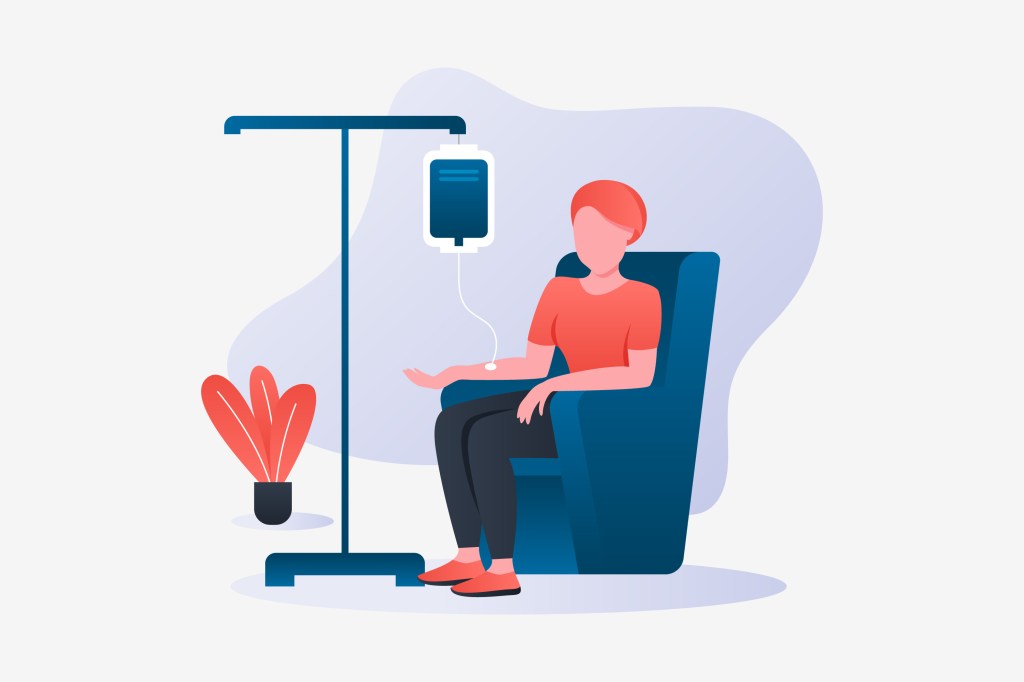
Les quatre premières cures se font à l’hôpital de jour. Je ne suis jamais seule dans la salle d’attente, nous nous regardons sans nous regarder, tous avec nos bracelets blancs, nom-prénom-date de naissance, heureusement la télé est allumée et nous suivons avec intérêt une émission sans intérêt. Les chambres comportent généralement deux fauteuils inclinables, séparés par un rideau. La cure dure plusieurs heures, les poches de traitement et de nettoyage se succèdent, entrecoupées d’alarmes (fin de la poche, bulle d’air,…). Ambiance lourde, même si le personnel médical est top, bienveillant et empathique. J’ai la chance parfois d’être accompagnée, mais les discussion sont limitées et à voix basse pour ne pas déranger l’autre malade.
En décembre on me propose de passer en HAD(hospitalisation à domicile) ce que j’accepte avec grand plaisir. Un(e) infirmier(ère) passe à la maison avec tout le matériel et la vie continue pendant la durée des perfusions. Je me sens moins malade et j’apprends à connaître ces femmes et ces hommes qui allient professionnalisme, adaptation et bienveillance. Cette complicité est formidable, et je m’en sers comme d’une arme supplémentaire pour enrichir mon arsenal.
_____________________________________________________________________________________________
The results of the molecular biology analysis (BRAF V600E mutation) made it possible to consider two treatments: a targeted therapy, or the combination Carboplatin – Alimta – Pembrolizumab (two chemotherapies and one immunotherapy) over four cycles spaced three weeks apart.
I was fortunate to have a high PD-L1 score — 80% (PD-L1 stands for Programmed cell Death protein 1) — which suggests good effectiveness of immunotherapy.
So the second option was chosen, after consultation with several university hospitals and in agreement with the second opinion (Gustave Roussy Institute), followed by maintenance treatment with Alimta – Pembrolizumab. Targeted therapy could be offered as a second-line treatment.
The first four cycles took place in the day hospital. I was never alone in the waiting room; we looked at each other without really looking, all wearing our white bracelets with name–surname–date of birth. Thankfully, the TV was on, and we watched uninteresting shows with great interest. The treatment rooms usually had two reclining chairs separated by a curtain. Each session lasted several hours, with treatment IV bags and flushing IV bags following one another, punctuated by alarms (end of the IV bag, air bubble…). The atmosphere was heavy, even though the medical staff were wonderful — kind and empathetic. I was lucky to sometimes be accompanied, but conversations were limited and whispered so as not to disturb the other patient.
In December, they offered me home hospitalization (HAD), which I accepted with great pleasure. A nurse came to the house with all the equipment, and life continued during the infusions. I felt less sick, and I got to know these women and men who combine professionalism, adaptability, and kindness. This bond was extraordinary, and I used it as an additional weapon to strengthen my arsenal.


Votre commentaire